

Results / Funari Public Adjusters
Helping a Public Adjuster Get More Local Leads with Search and Ads

The Challenge
Funari is a local public-adjusting firm. They help people with storm, fire, and water damage. But people in Pennsylvania, New Jersey, and Delaware had trouble finding them online for the searches that lead to real claims. Funari needed:
- better visibility for searches about roof, fire, flood, and pipe damage.
- a stronger local presence, including better Google Business Profile pages and location pages.
- a modern SEO plan that fixed the site, built local content, and created helpful videos so the site would show up in regular search and in AI-powered answer tools.
Industry
The Approach
We built a steady program that combined three things: organic search work (SEO), pay-per-click (PPC), and mobile and digital advertising. All work was tracked and data was enhanced over time via A/B and multivariate testing.
SEO (organic search)
- We started with a full audit of the site. It analyzed crawling, indexing, page speed, structured data, and Google Business Profile pages.
- We improved technical issues like canonical tags, metadata, internal links, and performance so the site would be easier to navigate for consumers. Moreover, the changes improved search rankings.
- We built and kept improving local pages for each vertical market and made sure Google Business Profile listings were accurate.
- We ran a steady content program: service pages, blog posts for high-intent damage questions, and short videos that answer common questions people search for.
- We updated the site on a regular schedule so fixes and new content stuck and kept improving over time.
- We also provided short, clear answers that helped AI search tools find and use the site’s content.
PPC (pay-per-click)
- We set up local search ads that targeted people looking for help after roof, flood, or fire damage.
- Ad groups and keywords matched each service and location so Philly area residents saw ads that fit what they needed.
- Ads sent people to landing pages that matched the ad message and the local pages designed to optimize search rankings.
- We tested ad text, adjusted bids, and analyzed that data that led to calls and form fills. Then we focused our budget on the best performers.
Paid advertising (other paid channels)
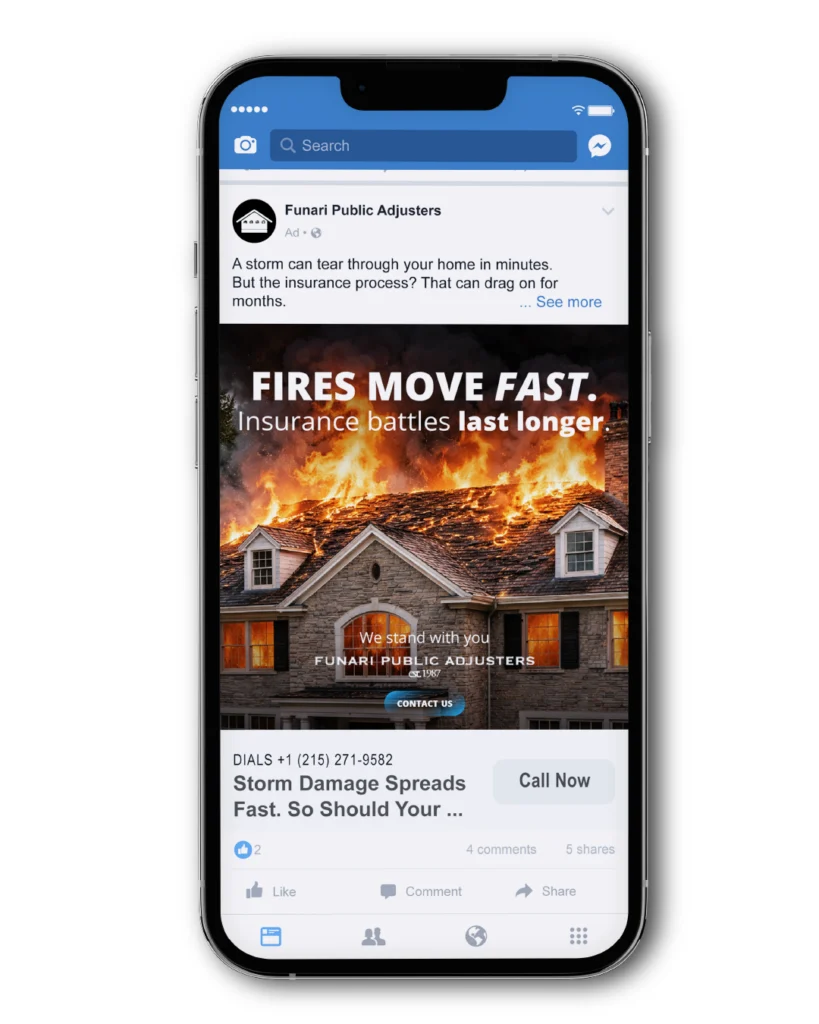
- We ran paid campaigns on social and display networks to raise awareness in the local areas that Funari serves.
- We used short video ads to reach people who might need help after weather or accident-related damage.
- We used remarketing to bring back people who visited the site but ahdn’t yet converted.
- Paid ads were coordinated with the SEO content so visitors saw the same helpful message no matter how they found Funari.
Measurement and ongoing work
- We tracked everything in Google Analytics 4 and reviewed results weekly and monthly.
- Data told us what to enhance next: technical tasks, new pages, or ad changes.
- The program was not a one-time push. We kept working, measuring, and improving.
Industry
The Challenge
Funari is a local public-adjusting firm. They help people with storm, fire, and water damage. But people in Pennsylvania, New Jersey, and Delaware had trouble finding them online for the searches that lead to real claims. Funari needed:
- better visibility for searches about roof, fire, flood, and pipe damage.
- a stronger local presence, including better Google Business Profile pages and location pages.
- a modern SEO plan that fixed the site, built local content, and created helpful videos so the site would show up in regular search and in AI-powered answer tools.
The Approach
We built a steady program that combined three things: organic search work (SEO), pay-per-click (PPC), and mobile and digital advertising. All work was tracked and data was enhanced over time via A/B and multivariate testing.
SEO (organic search)
- We started with a full audit of the site. It analyzed crawling, indexing, page speed, structured data, and Google Business Profile pages.
- We improved technical issues like canonical tags, metadata, internal links, and performance so the site would be easier to navigate for consumers. Moreover, the changes improved search rankings.
- We built and kept improving local pages for each vertical market and made sure Google Business Profile listings were accurate.
- We ran a steady content program: service pages, blog posts for high-intent damage questions, and short videos that answer common questions people search for.
- We updated the site on a regular schedule so fixes and new content stuck and kept improving over time.
- We also provided short, clear answers that helped AI search tools find and use the site’s content.
PPC (pay-per-click)
- We set up local search ads that targeted people looking for help after roof, flood, or fire damage.
- Ad groups and keywords matched each service and location so Philly area residents saw ads that fit what they needed.
- Ads sent people to landing pages that matched the ad message and the local pages designed to optimize search rankings.
- We tested ad text, adjusted bids, and analyzed that data that led to calls and form fills. Then we focused our budget on the best performers.
Paid advertising (other paid channels)
- We ran paid campaigns on social and display networks to raise awareness in the local areas that Funari serves.
- We used short video ads to reach people who might need help after weather or accident-related damage.
- We used remarketing to bring back people who visited the site but ahdn’t yet converted.
- Paid ads were coordinated with the SEO content so visitors saw the same helpful message no matter how they found Funari.
Measurement and ongoing work
- We tracked everything in Google Analytics 4 and reviewed results weekly and monthly.
- Data told us what to enhance next: technical tasks, new pages, or ad changes.
- The program was not a one-time push. We kept working, measuring, and improving.
The Outcome
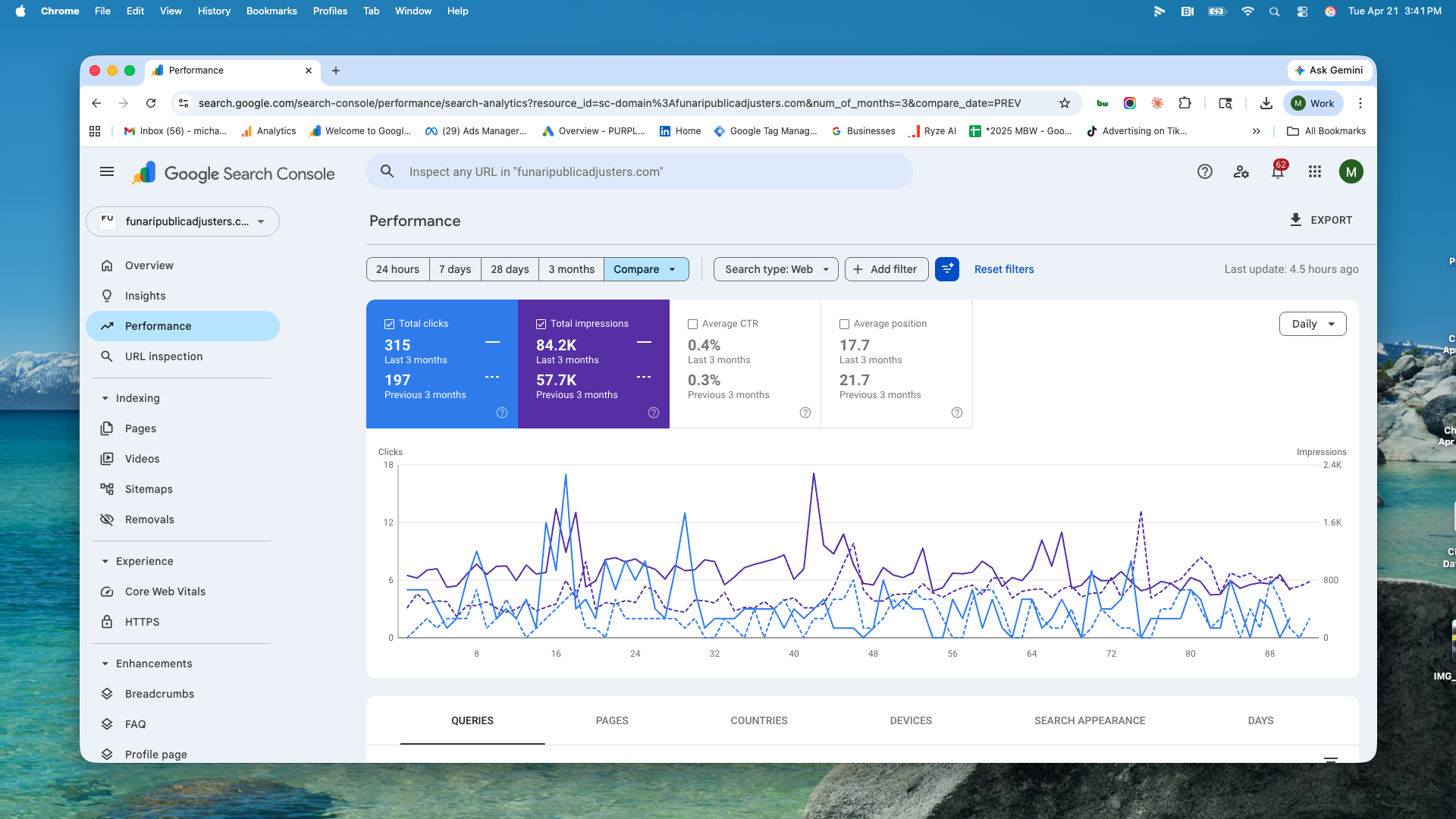
Because the work was continuous, gains built up over time. Highlights:
- Organic search became the largest traffic driver during key periods after severe weather had impacted the region
- We created a repeatable playbook: keep Google Business Profile up to date, make local landing pages, produce short video assets, and do regular technical repairs. Those steps were refreshed and scaled over time to maintain and grow rankings.
Bottom line
Helping Funari took steady work on three fronts: SEO, PPC, and paid advertising. SEO built a strong base with local pages, technical fixes, and helpful content. PPC and other paid work brought immediate visibility and more leads while we built organic strength. Tracking and repeating what worked made the results sustainable.